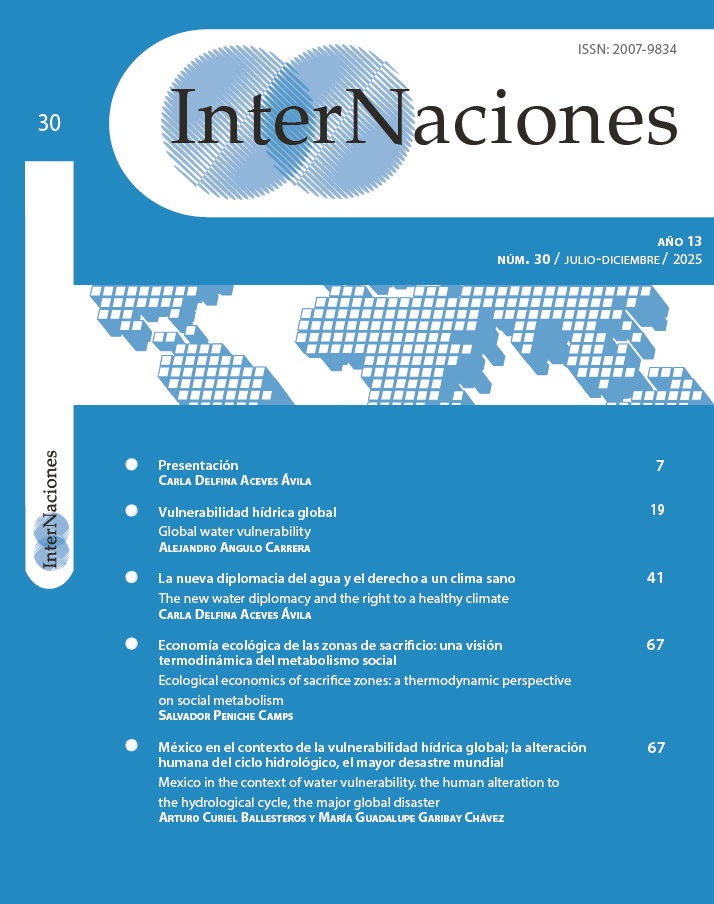
Mexico in the Context of Water Vulnerability:
The Human Alteration to the Hydrological Cycle, the Major Global Disaster.
DOI:
https://doi.org/10.32870/in.vi30.7316Keywords:
Hydrometeorological hazards, water vulnerability, the global vulnerability, water governance, climate changeAbstract
The alteration of the hydrological cycle with human activities is the highest natural disaster of the last two centuries. That has caused a greater intensity and frequency in periods of drought, floods and hurricanes in several regions in the world. In this global context, the vulnerability of Mexico is analyzed, and in particular the political vulnerability, since most of the actions that continue to be proclaimed by the national government, without the international context that is necessary to solve the crises, are still insisted on local processes, instead of discussing with other actors the various problems of hazards and water vulnerability water vulnerability and possible options to be implemented within public policies that include promotion of technologies and culture that can stop in the short term and reverse in the medium term, the various forces and pressures that have decreased access to water in sufficient volume and quality.Downloads
References
C40 Cities. (21 de enero de 2015). City Climate Hazard Taxonomy, https://www.c40.org/wp-content/static/researches/images/33_C40_Arup_Climate_Hazard_Typology.original.pdf?1426352208.
Comisión Nacional del Agua. (16 de diciembre de 2024). 10 Compromisos por el agua;
Acuerdo Nacional por el Derecho Humano al Agua y la Sustentabilidad. https://www.gob.mx/conagua/articulos/10-compromisos-por-el-agua?idiom=es.
EM-DAT, International Disaster Database, Center for Research on the Epidemiology of Disasters, University of Louvain (29 de junio de 2025). Access Data, https://public.emdat.be/.
Guillén, B. (26 de noviembre de 2022). El pueblo mexicano que se está tragando el mar. El País. https://elpais.com/mexico/2022-11-27/el-pueblo-mexicano-que-se-trago-el-mar.html.
Goldman, E., Carter, S., y Sims, M. (20 de mayo de 2025). Los incendios impulsaron una pérdida récord de bosques tropicales en el 2024, World Resourses Institute. https://es.wri.org/insights/los-incendios-impulsaron-una-perdida-record-de-bosques-tropicales-en-el-2024.
González, M. y García, D. (2007). Restauración de Ríos; Guía metodológica para la elaboración de proyectos. Madrid: Ministerio de Medio Ambiente del Gobierno de España
Graham, S., C., Parkinson, y M., Chahine. (01 de octubre de 2010). The Water Cycle. Earth Observatory Nasa, https://earthobservatory.nasa.gov/features/Water.
INECC, Instituto Nacional de Ecología y Cambio Climático. (29 de junio de 2025). Atlas Nacional de Vulnerabilidad al Cambio Climático, https://atlasvulnerabilidad.inecc.gob.mx/atlas/mapa.
International Monetary Fund. (2024). World Economic Outlook: Policy Pivot, Rising Threats. Washington, DC: International Monetary Fund.
Mongabay. (15 de junio de 2025). México entra en la lista de los 10 países con mayor pérdida de bosques primarios en el mundo durante 2024. https://www.noroeste.com.mx/inndaga/mexico-entra-en-la-lista-de-los-10-paises-con-mayor-perdida-de-bosques-primarios-en-el-mundo-durante-2024-CN13698857.
Naciones Unidas. (14 de junio de 1992). Informe de la Conferencia de las Naciones Unidas Sobre el Medio Ambiente y el Desarrollo. https://www.un.org/esa/documents/ga/conf151/spanish/aconf15126-3s.htm.
OECD. (5 de diciembre de 2023). PISA 2022 Results (Volume I and II) - Country Notes: Mexico. https://www.oecd.org/en/publications/pisa-2022-results-volume-i-and-ii-country-notes_ed6fbcc5-en/mexico_519eaf88-en.html#chapter-d1e11.
Organización Mundial de la Salud (8 de enero de 2024). Proporción de la población que utiliza servicios de agua potable gestionados de forma segura (%). https://data.who.int/es/indicators/i/5131A52/1548EA3.
Organización Mundial de la Salud (8 de enero de 2024). Tasa de mortalidad atribuida a la exposición a servicios de agua, saneamiento e higiene inseguros (por 100 000 habitantes). https://data.who.int/es/indicators/i/C123B15/ED50112.
Ruhr University Bochum, Institute for International Law of Peace and Conflict. (2024). World Risk Report 2024. https://weltrisikobericht.de/worldriskreport.
Santillán, M. L. (23 de septiembre de 2019). Desiertos, espacios de interacción y amplia diversidad biológica, https://ciencia.unam.mx/leer/902/desiertos-espacios-de-interaccion-y-amplia-diversidad-biologica
Webster, P. (noviembre de 1994). The role of hydrological processes in ocean-atmosphere interaction. Reviews of Geophysics, 32 (4), pp. 427-476.
Wilches-Chaux, G. (1993). La vulnerabilidad global. En: A. Maskrey (Comp.), Los desastres no son naturales (pp. 11-44). Panamá: Red de Estudios Sociales en Prevención de Desastres en América Latina
Downloads
Published
How to Cite
Issue
Section
License
Copyright (c) 2025 University of Guadalajara

This work is licensed under a Creative Commons Attribution-NonCommercial-ShareAlike 4.0 International License.
CC BY-NC-SA 4.0 https://creativecommons.org/licenses/by-nc-sa/4.0/